Showing posts with label english. Show all posts

Saturday, June 27, 2020

A Guide to the Good Life: my notes

The following are my notes for the "A Guide to the Good Life: The Ancient Art of Stoic Joy" book.

Main points
  • tranquility ↔ virtue
  • art of living
  • contemplate bad things to: prevent them from happening, lessen their impact when they happen, prevent boredom
  • learn how to want the things we already have
  • negative visualizations : wife, job, theft, house burnt down, gone blind, death of other persons, own death
  • enjoy what we have without clinging to it = every time we do something could be the last time we do it
  • trichotomy of control : there are things over which we have complete control, things over which we have no control at all, and things over which we have some but not complete control
  • internal goals instead of external goals
  • we should periodically cause ourselves to experience discomfort that we could easily have avoided ⇒ voluntary discomfort (vaccine) ⇒ we might periodically allow ourselves to become thirsty or hungry
  • insults ⇒ respond with humor (including self-deprecating humor)
  • evolution favored goals to maximize our chances to reproduce, not to maximize our happiness ⇒ it favored social status, more of anything we already have, etc.
Among their recommendations were the following
  • "We should become self-aware: We should observe ourselves as we go about our daily business, and we should periodically reflect on how we responded to the day’s events. How did we respond to an insult? To the loss of a possession? To a stressful situation? Did we, in our responses, put Stoic psychological strategies to work?"
  • "We should use our reasoning ability to overcome negative emotions. We should also use our reasoning ability to master our desires, to the extent that it is possible to do so. In particular, we should use reason to convince ourselves that things such as fame and fortune aren’t worth having—not, at any rate, if what we seek is tranquility—and therefore aren’t worth pursuing. Likewise, we should use our reasoning ability to convince ourselves that even though certain activities are pleasurable, engaging in those activities will disrupt our tranquility, and the tranquility lost will outweigh the pleasure gained."
  • "If, despite not having pursued wealth, we find ourselves wealthy, we should enjoy our affluence; it was the Cynics, not the Stoics, who advocated asceticism. But although we should enjoy wealth, we should not cling to it; indeed, even as we enjoy it, we should contemplate its loss."
  • "We are social creatures; we will be miserable if we try to cut off contact with other people. Therefore, if what we seek is tranquility, we should form and maintain relations with others. In doing so, though, we should be careful about whom we befriend. We should also, to the extent possible, avoid people whose values are corrupt, for fear that their values will contaminate ours."
  • "Other people are invariably annoying, though, so if we maintain relations with them, they will periodically upset our tranquility—if we let them. The Stoics spent a considerable amount of time devising techniques for taking the pain out of our relationships with other people. In particular, they came up with techniques for dealing with the insults of others and preventing them from angering us."
  • "The Stoics pointed to two principal sources of human unhappiness—our insatiability and our tendency to worry about things beyond our control—and they developed techniques for removing these sources of unhappiness from our life."
  • "To conquer our insatiability, the Stoics advise us to engage in negative visualization. We should contemplate the impermanence of all things. We should imagine ourselves losing the things we most value, including possessions and loved ones. We should also imagine the loss of our own life. If we do this, we will come to appreciate the things we now have, and because we appreciate them, we will be less likely to form desires for other things. And besides simply imagining that things could be worse than they are, we should sometimes cause things to be worse than they would otherwise be; Seneca advises us to “practice poverty,” and Musonius advises us voluntarily to forgo opportunities for pleasure and comfort."
  • "To curb our tendency to worry about things beyond our control, the Stoics advise us to perform a kind of triage with respect to the elements of our life and sort them into those we have no control over, those we have complete control over, and those we have some but not complete control over. Having done this, we should not bother about things over which we have no control. Instead, we should spend some of our time dealing with things over which we have complete control, such as our goals and values, and spend most of our time dealing with things over which we have some but not complete control. If we do this, we will avoid experiencing much needless anxiety."
  • "When we spend time dealing with things over which we have some but not complete control, we should be careful to internalize our goals. My goal in playing tennis, for example, should be not to win the match but to play the best match possible."
  • We should be fatalistic with respect to the external world: We should realize that what has happened to us in the past and what is happening to us at this very moment are beyond our control, so it is foolish to get upset about these things.
Practice
  • "At spare moments in the day, make it a point to contemplate the loss of whatever you value in life."
  • "After mastering negative visualization, a novice Stoic should move on to become proficient in applying the trichotomy of control."
  • "As a Stoic novice, you will want, as part of becoming proficient in applying the trichotomy of control, to practice internalizing your goals."
  • "In your practice of Stoicism, you will also want, in conjunction with applying the trichotomy of control, to become a psychological fatalist about the past and the present—but not about the future."
  • "Self-deprecating humor has become my standard response to insults. When someone criticizes me, I reply that matters are even worse than he is suggesting."
  • "I have experimented with a program of voluntary discomfort. I have not attempted to go barefoot, as Musonius suggested, but I have tried less radical behavior, such as under-dressing for winter weather, not heating my car in the winter, and not air conditioning it in the summer."

Monday, February 3, 2020

Learning How to Learn: my notes

The following are my notes for the "Learning How to Learn" Coursera course:
  • pomodoro: to counter procrastination, do something, at least for some time, discomfort will then disappear ; then reward yourself
  • if you’re stuck: take a break, take a walk, daydream (i.e. alternate between focused and diffuse mode)
  • spaced repetitions (i.e. avoid cramming)
  • sleep/dreams: helps learning
  • physical exercise: helps the brain (helps new neurons to be used/created)
  • we can hold only 4 pieces of information in our conscious mind at the same time
  • link between anxiety/depression and procrastination, perfectionism, fear of failure, habit, pain avoidance, etc.
  • creativity/problems: it helps to zoom in and zoom out to have different perspectives (i.e. look at details but also wonder “Why am I doing this?”, etc.) ; zooming out = consciously do what sleeping/walking/daydreaming does unconsciously
  • writing tips
    • do not edit (i.e. re-read) while writing ⇒ hide what’s before what you’re writing
    • do not outline (really ?)
    • try to be in diffuse mode (rather than focused mode) while writing the core of the text, then re-read (i.e. edit) yourself
  • practice + repetition ⇒ chunks of knowledge (me: “Chunks are little networks of information that gradually become units of knowledge through practice and repetition”)
  • chunks = easy-to-access items
  • forming chunks: bits by bits, steps by steps, repetition
  • example of big picture process: look at the chapters of a book/course
  • chunking: focused attention, understanding, practice
  • practice and recall (i.e. actively recalling what you just learnt) leads to better learning
  • recall = mental retrieving of the key ideas
  • summing up ideas (in margins) instead of highlighting (which gives the illusion of understanding/competence)
  • tip: change the environment (i.e. physical place where you are learning)
  • chunks can be applied in different context (transfer)
  • an initial idea of how to do something can prevent better ideas (i.e. intuitions can be misleading)
  • mistakes are good (help fight the illusion of competence)
  • interleaving (e.g. skipping around exercices, etc.): helps learning more deeply
  • 4 parts of habits
    • the cue (e.g. seeing the first item on your to-do list)
      • location
      • time
      • how you feel
      • reactions
    • the routine (= zombie mode)
      • plan (e.g. ritual like having a favorite chair)
    • the reward
      • find a more rewarding reward than procrastination
      • mini-deadlines usually work well
    • the belief (we need to change our underlying beliefs to develop habits)
      • gain trust in your new system
  • tackling procrastination: process bit by bit, day after day
  • tip: focus on process, not product (e.g. aim for spending 20 minutes working, instead of finishing something) ⇒ it’s important to “just start” something (hence the effectiveness of pomodoro)
  • tip: quiet space (or noise-cancelling headphones)
  • willpower: only needed to change your reaction to the cue
  • weekly/daily to-do lists
    • choosing tasks for a day the day before is good (night ⇒ put you in zombie mode)
    • mix tasks with walks or chores ⇒ gives the brain the space it needs (diffuse mode)
    • important to have break times
    • having a quitting time (e.g. 5 PM) is good
    • don’t be too unsettled by unexpected events, meetings, obligations, etc. (they’re part of life)
    • starting by what you least want to do (at least for a while) might be a good idea
  • tip to learn: visualize things, use sounds as well (i.e. say things out loud)
  • tip to learn: use flash cards ⇒ interleave + spaced repetition (e.g. repeat something just going to bed)
  • learning “hacks” such as visualizing list items in a familiar place actually help “real learning” (i.e. it’s not only a quick hack to memorize lists)
  • tip: funny visualizations are more efficient
  • memory = long term memory + working memory
  • use groups/associations (between numbers and familiar dates, for example)
  • metaphors/analogies
  • Einstellung is “the development of a mechanized state of mind. Often called a problem solving set, Einstellung refers to a person's predisposition to solve a given problem in a specific manner even though better or more appropriate methods of solving the problem exist.” = “being blocked by thinking about a problem in the wrong way”
  • being smart/intelligent might mean being able to hold more things in your working memory (e.g. 9 instead of 4), but it also makes being creative more difficult, because you are more likely to get stuck by Einstellung
  • imposter syndrome is very common
  • perseverance = the virtue of the less brilliant (actually a good thing to go further than what your intelligence alone allows you to go)
  • studying with others: allows to check if you really understood something or not
  • tests: revisit your answers (take a “big picture” perspective)
  • tests: begin with hard problems first, quickly switch to easy problems if stuck (to trigger the diffuse mode) = hard start - jump to easy
  • calm yourself by deep breathing (belly must move, not the chest)
  • procrastination tip: set appointments with yourself

Wednesday, October 17, 2018

Cheapest vegan omega-3 supplements on the market

It has been known for years now that omega-3 supplements are useless for heart health. They're still useful for brain health, though, especially for vegetarians, vegans, and people who don't eat fish regularly (i.e. most people I know, probably).

I've been taking vegan (i.e. algae) omega-3 supplements since 2007 and I've always bought the same brand: Nuique (previously called V-Pure). I'm aiming for a low omega-6-to-omega-3 ratio (2:1, ideally 1:1). The average ratio in the US is apparently 17:1. I'm currently at 3.5:1 (with an omega-3 index of 14.4%). Not bad. I can probably do better, but I'm quite happy with those numbers.

Vegan omega-3 supplements are quite expensive, unfortunately, so, recently, I've tried to find a cheaper alternative to Nuique. Here are the products I've considered and the price in USD per 1000 mg of DHA for each product:
Conclusion: Vegetology is the cheapest vegan omega-3 supplement I've found so far and it is significantly cheaper than Nuique. They also seem to have vegan D3 supplements, which I thought was impossible (D3 supplements are usually made from sheep wool). So it's settled: I'll give my money to Vegetology from now on.

Thursday, December 21, 2017

Having fun with the IMDb dataset files

What follows are some raw statistics and plots that I generated using imdb-stats, a small project written in Scala, gnuplot, and the IMDb dataset files. This is work in progress.

Note: I'm not a statistician (obviously).

As of December 21, 2017, there are 4,700,498 titles in the IMDb dataset files.

Title types

Titles can be partitioned into 10 different types:
  • TV episode: 3,120,588 (66.39%)
  • Short film: 596,395 (12.69%)
  • Feature film: 471,950 (10.04%)
  • Video: 189,542 (4.03%)
  • TV series: 139,903 (2.98%)
  • TV movie: 121,916 (2.59%)
  • TV mini-series: 20,912 (0.44%)
  • Video game: 20,707 (0.44%)
  • TV special: 10,422 (0.22%)
  • TV short: 8,163 (0.17%)

Years

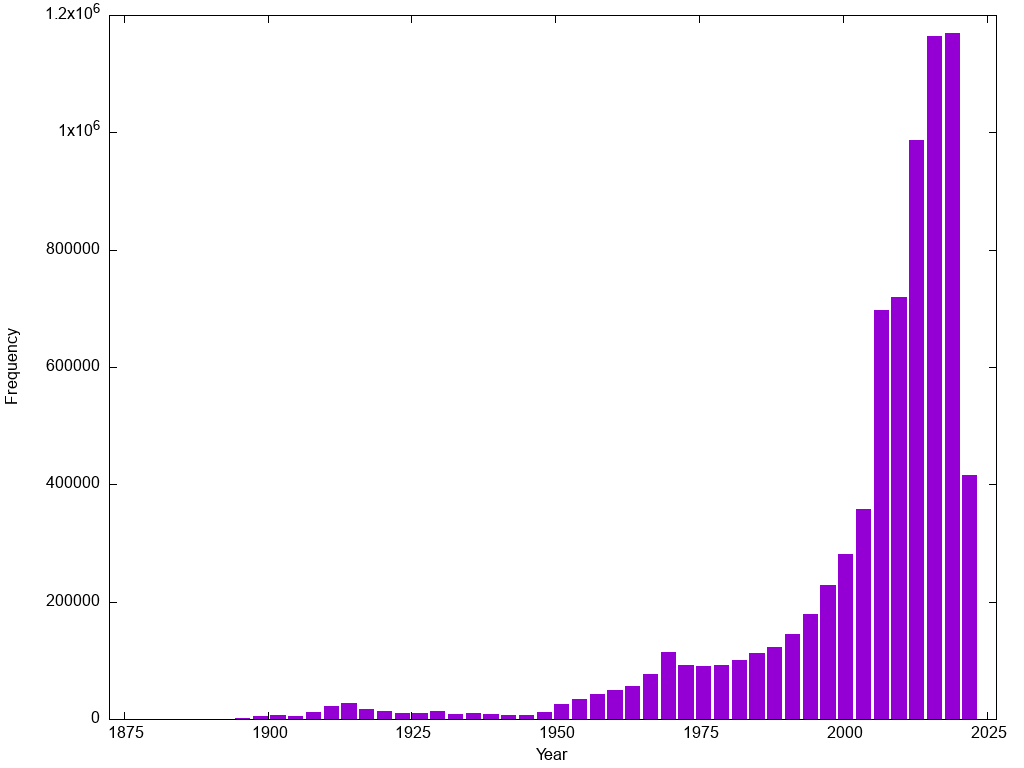
4,430,900 titles (94.26%) have a start and/or end year defined:
  • minimum: 1,874.00
  • maximum: 2,115.00
  • mean: 1,999.21
  • median: 2,008.00
  • mode: 2,016.00
  • standard deviation: 22.40
The earliest title in IMDb is The Passage of Venus (1874). And, yes, 100 Years is planned for release in 2115!

Durations

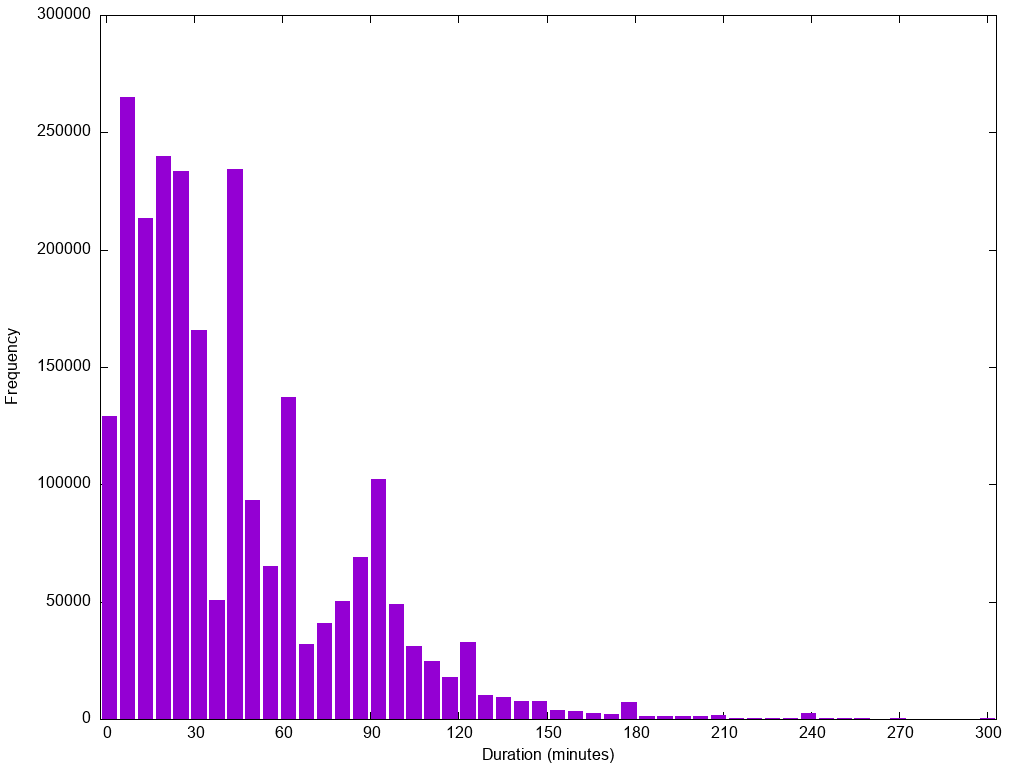
1,445,426 titles (30.75%) have a runtime duration defined:
  • minimum: 1.00
  • maximum: 125,156.00
  • mean: 46.79
  • median: 30.00
  • mode: 30.00
  • standard deviation: 116.51
Most durations above 1,000 minutes are experimental videos, total durations for series, mistakes, etc.
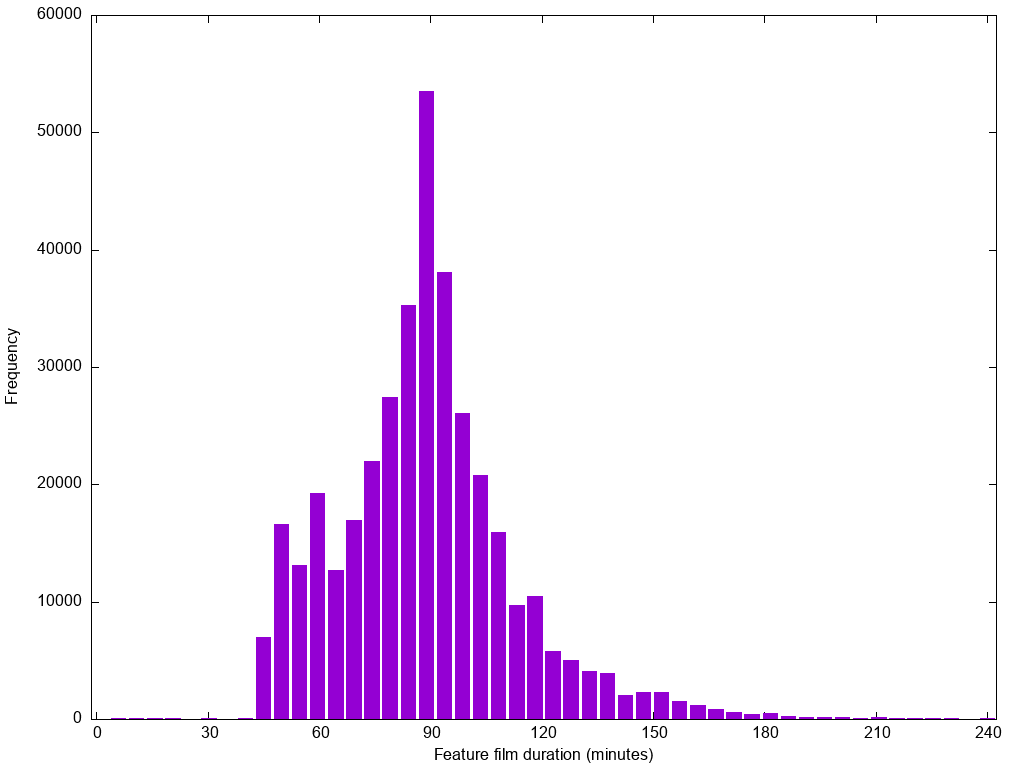
Here are the statistics and frequency plot for feature films only:
  • count: 292,149
  • minimum: 1.00
  • maximum: 14,400.00
  • mean: 87.51
  • median: 88.00
  • mode: 90.00
  • standard deviation: 53.54
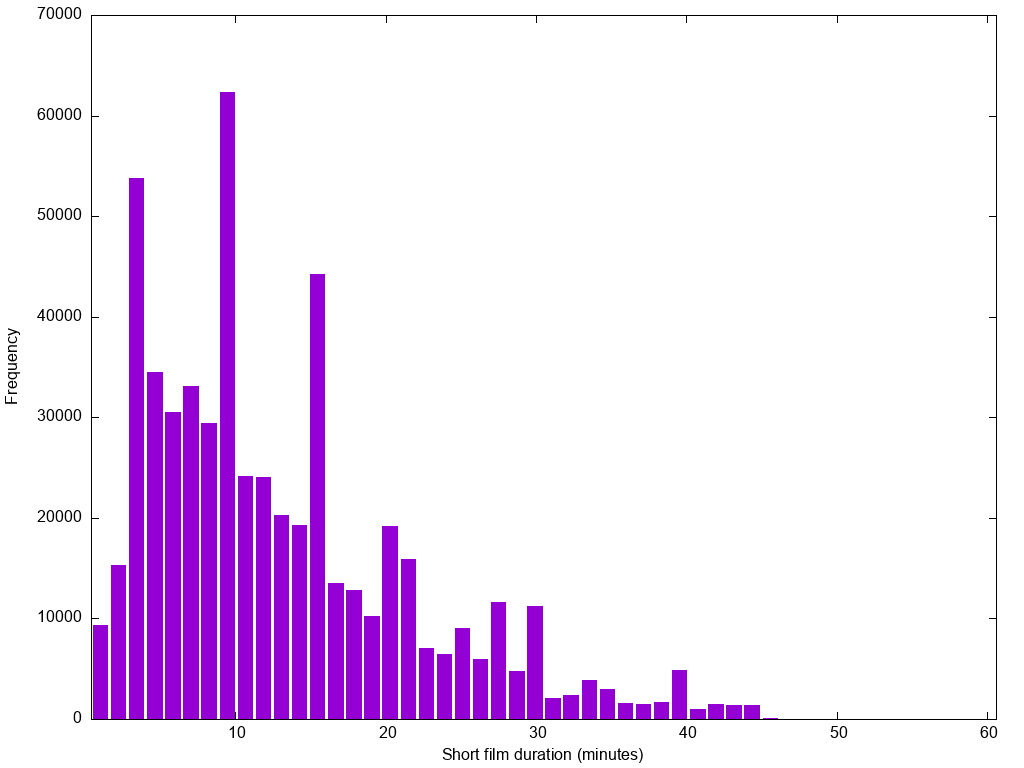
For short films only:
  • count: 388,272
  • minimum: 1.00
  • maximum: 1,834.00
  • mean: 13.27
  • median: 11.00
  • mode: 10.00
  • standard deviation: 10.04
There is some overlap between the short films and feature films. I'm not sure it totally makes sense (e.g. a feature film shorter than 10 minutes or a short film longer than 100 minutes?).

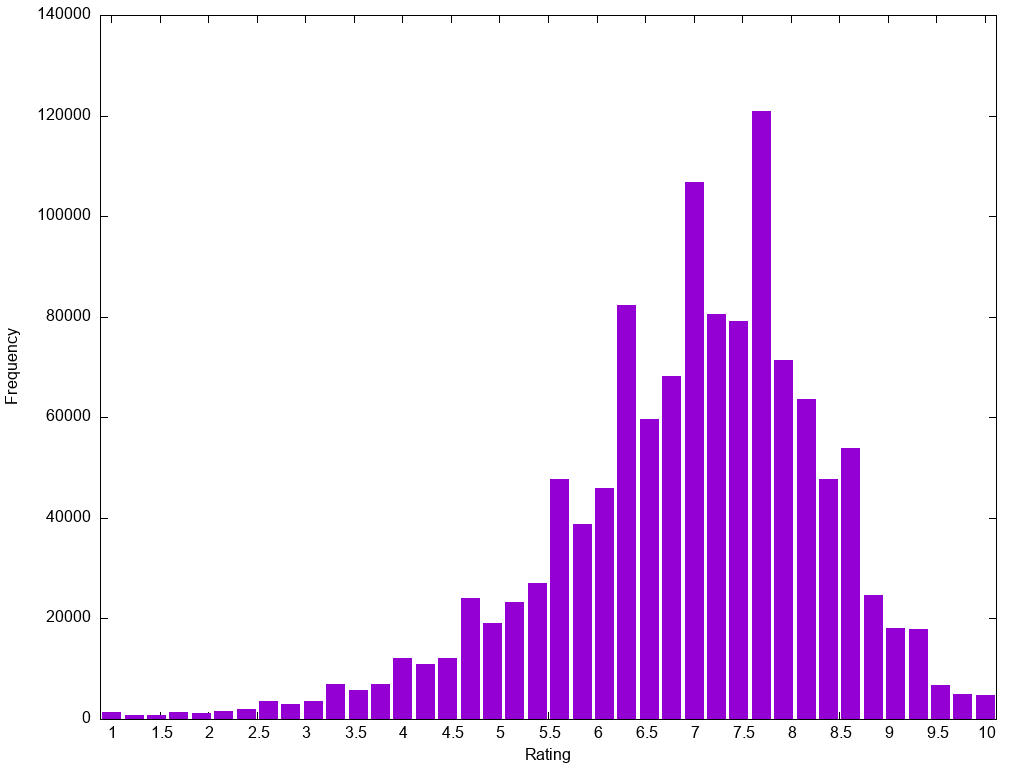
Ratings

789,386 titles (16.79%) have ratings.
  • minimum: 1.00
  • maximum: 10.00
  • mean: 6.94
  • median: 7.10
  • mode: 7.20
  • standard deviation: 1.39

Vote counts

Each title with a rating has at least 5 votes (this is a limit enforced by IMDb).
  • minimum: 5.00
  • maximum: 1,888,855.00
  • mean: 993.63
  • median: 20.00
  • mode: 5.00
  • standard deviation: 15,252.21
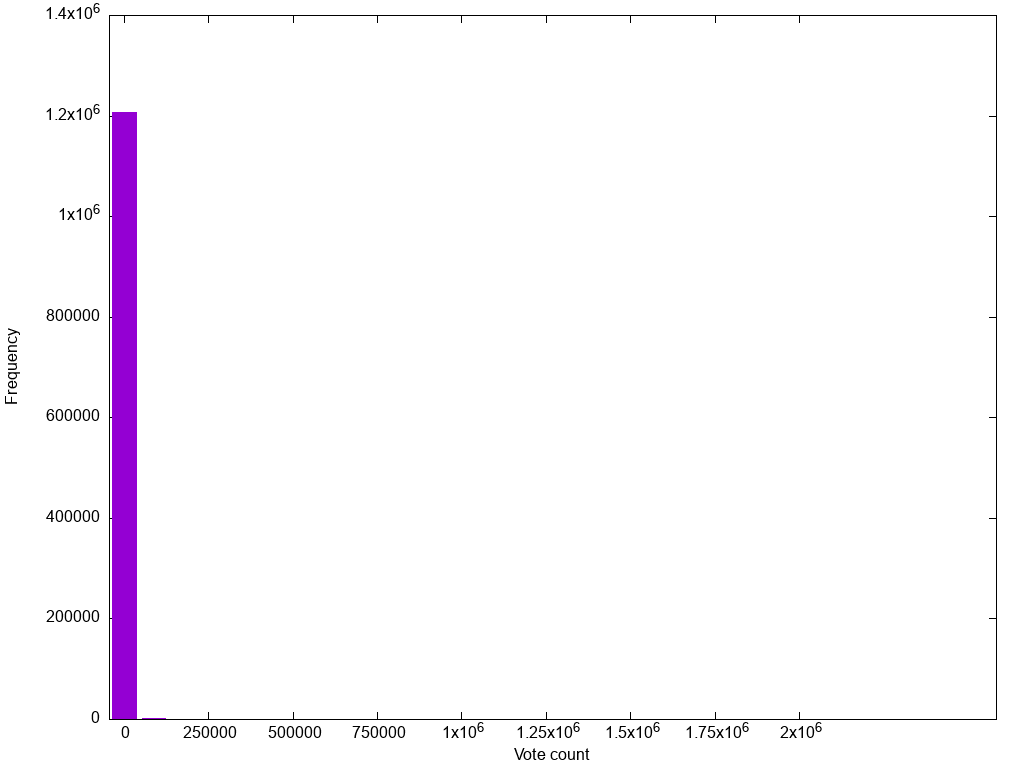
Most titles don't have much votes. The full frequency plot is not very useful:
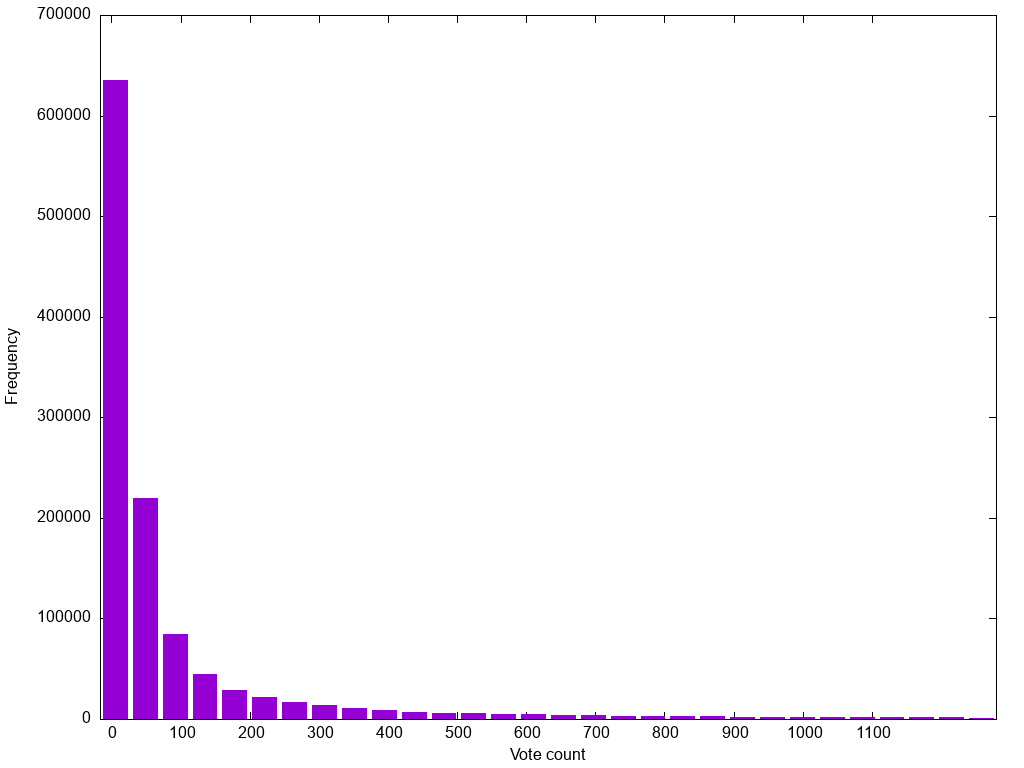
If we zoom to 1,100 votes and less, we can see what's happening a little bit better:
95% of the titles with votes are in that area (i.e. about 1,100 votes and less):
  • votes ≥ 10: 571,597 (72.41%)
  • votes ≥ 100: 174,492 (22.10%)
  • votes ≥ 1,000: 41,927 (5.31%)
  • votes ≥ 10,000: 8,560 (1.08%)
  • votes ≥ 100,000: 1,608 (0.20%)
  • votes ≥ 1,000,000: 23 (0.00%)
Here is a list of the titles with more than 1,000,000 votes:
  1. 1,888,855 votes: The Shawshank Redemption
  2. 1,864,479 votes: The Dark Knight
  3. 1,653,332 votes: Inception
  4. 1,513,857 votes: Fight Club
  5. 1,477,384 votes: Pulp Fiction
  6. 1,425,693 votes: Forrest Gump
  7. 1,369,869 votes: The Lord of the Rings: The Fellowship of the Ring
  8. 1,358,735 votes: The Matrix
  9. 1,349,685 votes: The Lord of the Rings: The Return of the King
  10. 1,289,627 votes: The Godfather
  11. 1,269,450 votes: The Dark Knight Rises
  12. 1,269,062 votes: Game of Thrones
  13. 1,221,666 votes: The Lord of the Rings: The Two Towers
  14. 1,151,888 votes: Se7en
  15. 1,120,080 votes: Interstellar
  16. 1,095,691 votes: Gladiator
  17. 1,089,898 votes: Batman Begins
  18. 1,087,575 votes: Django Unchained
  19. 1,076,266 votes: The Avengers
  20. 1,044,290 votes: Breaking Bad
  21. 1,018,092 votes: Star Wars: Episode IV - A New Hope
  22. 1,006,010 votes: The Silence of the Lambs
  23. 1,004,376 votes: Inglourious Basterds
Most (but not all) of those titles are feature films. The mean/median numbers of votes for feature films are greater than the mean/median numbers of votes for all titles:
  • minimum: 5.00
  • maximum: 1,888,855.00
  • mean: 3,108.20
  • median: 44.00
  • mode: 5.00
  • standard deviation: 28,483.48
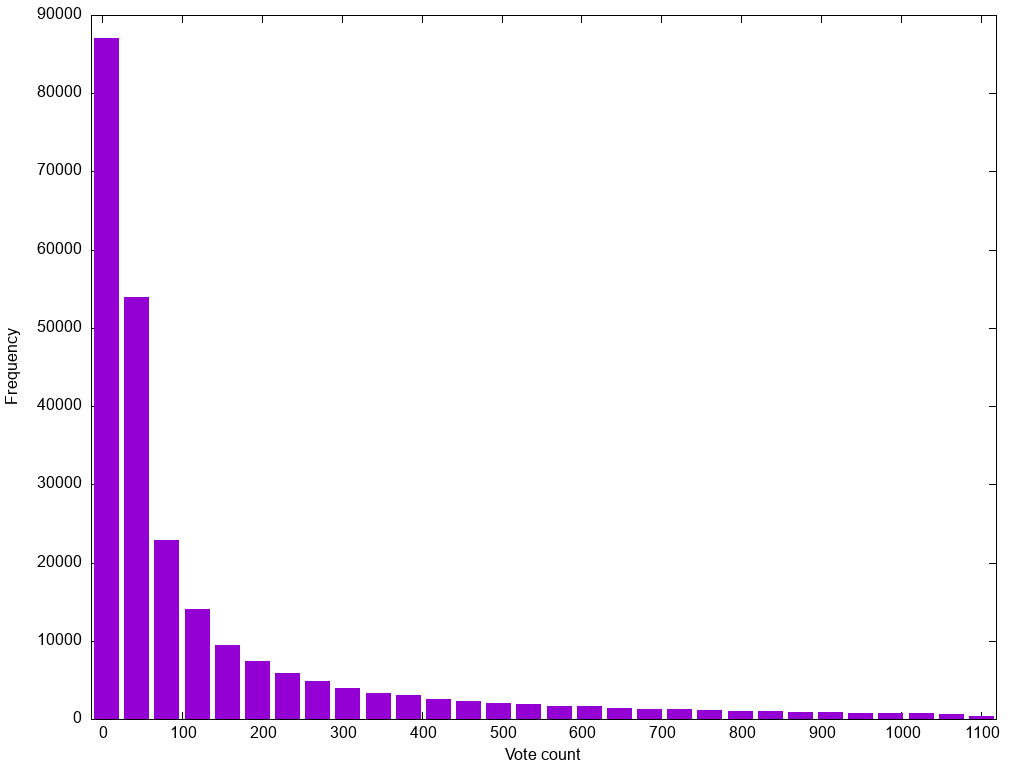
But the plot still doesn't look like a bell curve:
  • votes ≥ 10: 176,223 (83.02%)
  • votes ≥ 100: 77,743 (36.63%)
  • votes ≥ 1,000: 25,560 (12.04%)
  • votes ≥ 10,000: 7,250 (3.42%)
  • votes ≥ 100,000: 1,504 (0.71%)
  • votes ≥ 1,000,000: 21 (0.01%)

Minimum ratings

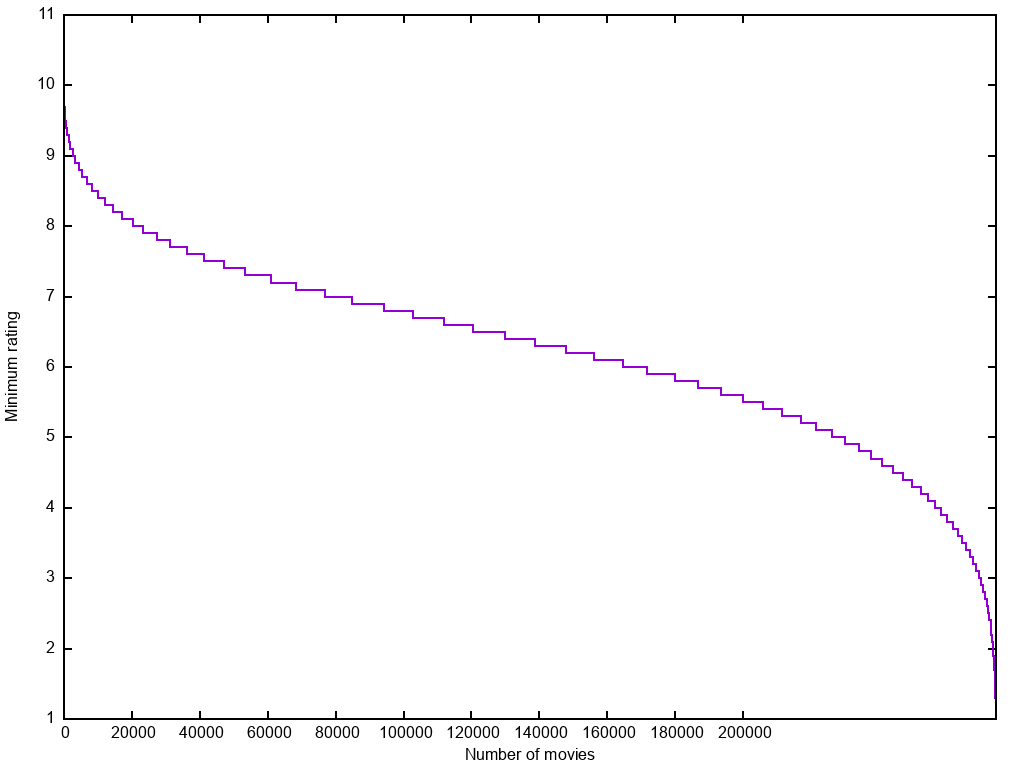
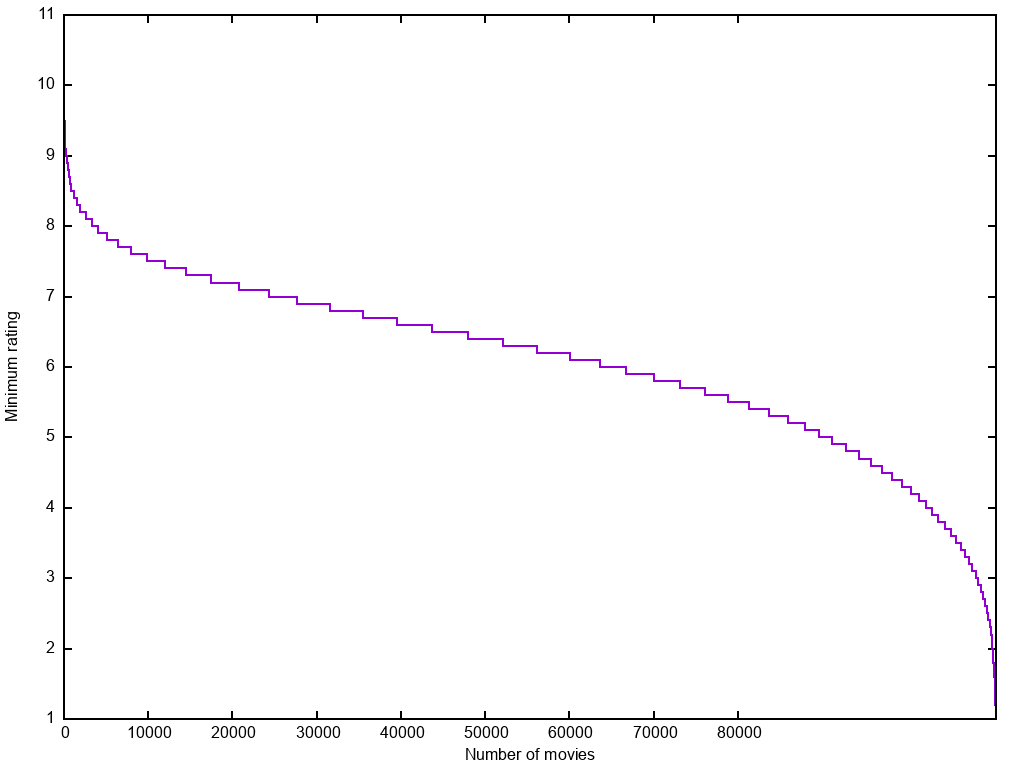
Question: what's the minimum IMDb rating for a feature film that you should watch if you can only watch N feature films in your life?

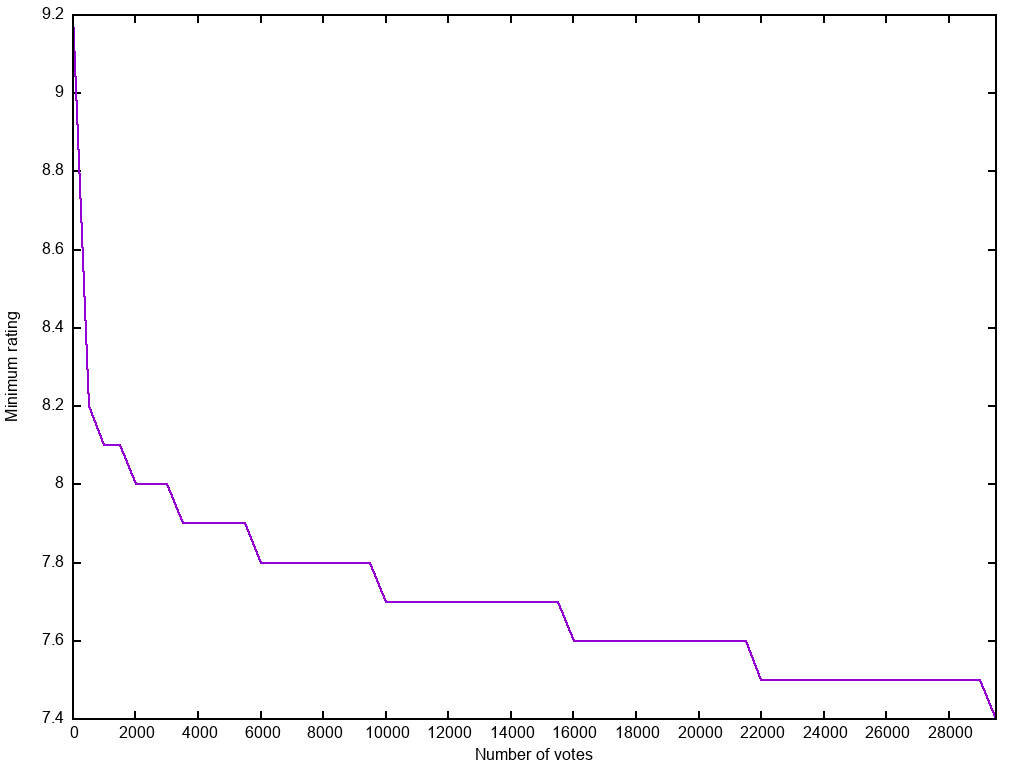
Here's the plot if you take into account all feature films with ratings:
If you take into account only feature films with 100 votes or more:
And now with 10,000 votes or more:
All the plots have the same shape: the more films you take, the less you have to be strict/conservative about the minimum rating. It makes complete sense.

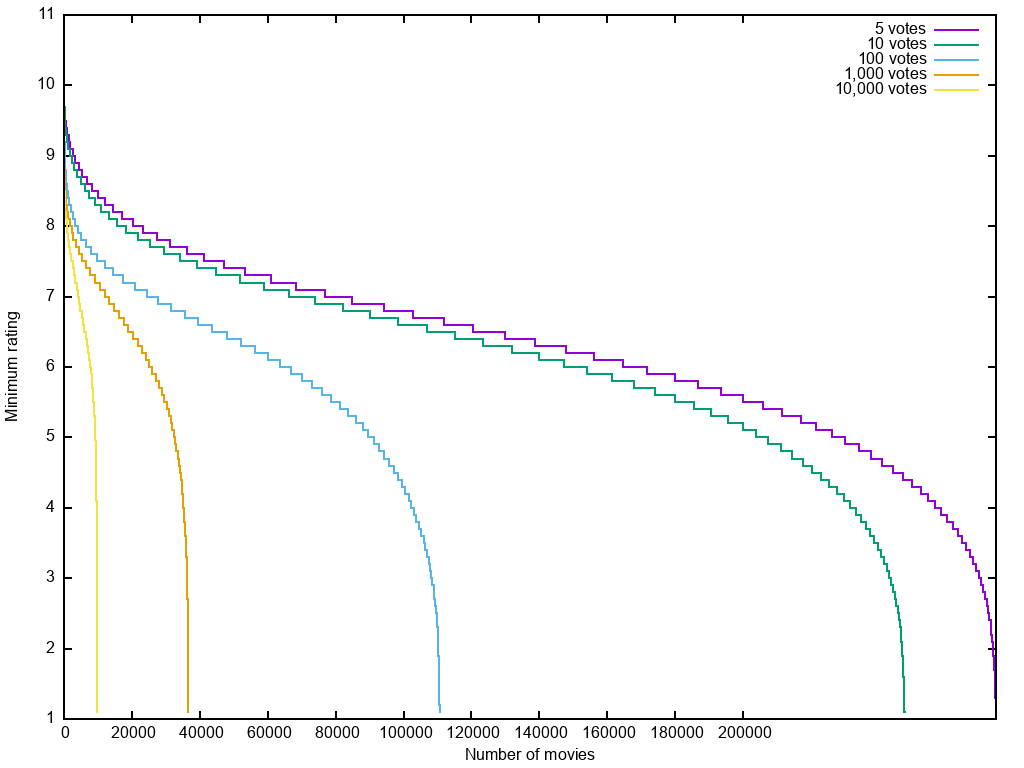
If you put all the plots on the same image, it becomes clear in what way the minimum number of votes influences the minimum rating:
The higher the number of votes, the lower the number of feature films there are with that many votes. In other words, you can be less strict/conservative about the minimum rating with movies that have lots of votes.

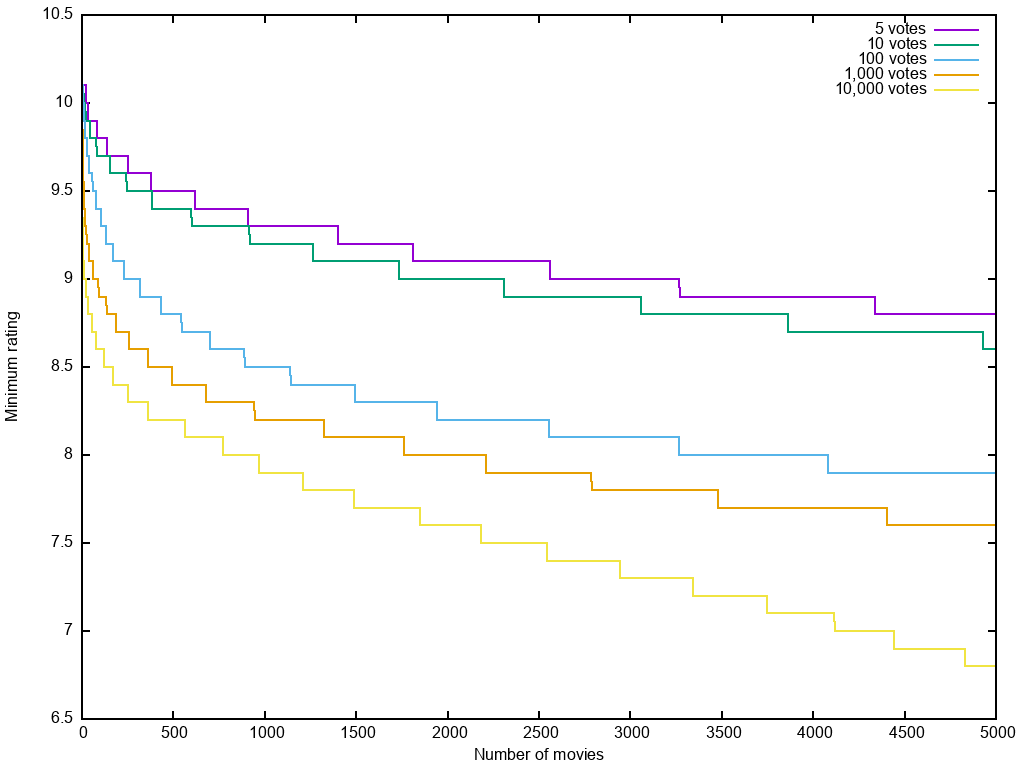
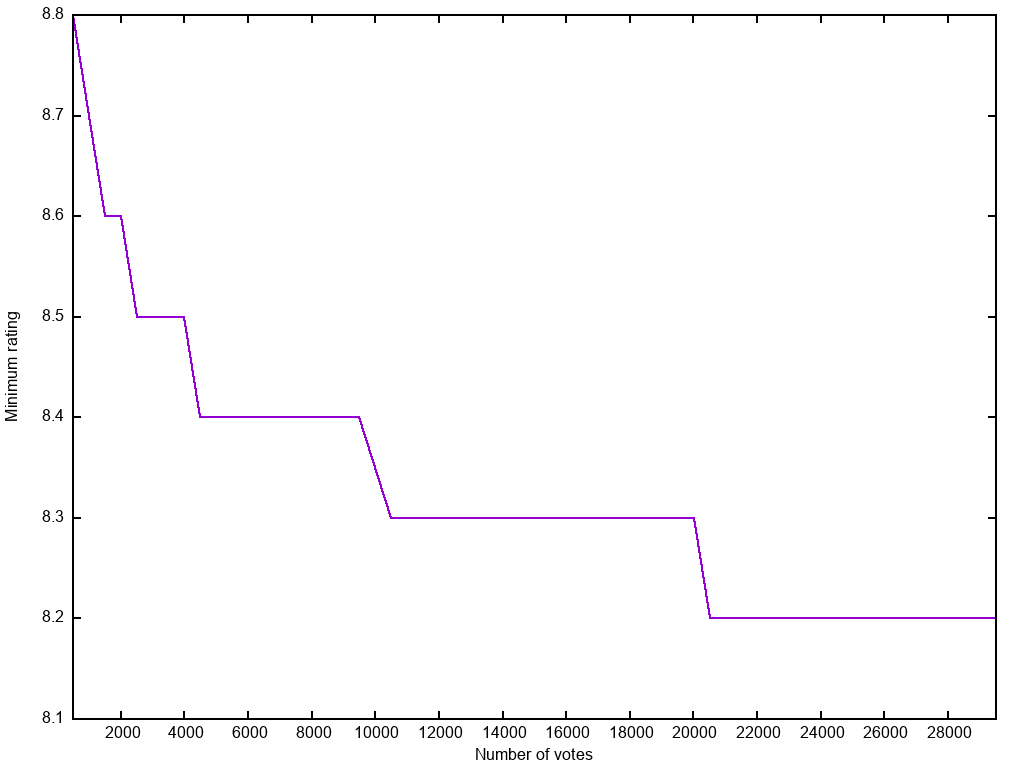
But let's be honest, shall we? You probably won't see more than 5,000 feature films in your entire life, unless you're a movie buff. So let's zoom a little:
At this scale, if becomes clear that the minimum number of votes becomes less important: the minimum rating doesn't go all the way down to 1; actually, it doesn't even go below 7.5 for most plots and doesn't go below ~6.5 for all of them. It appears that it's probably a good idea to stay clear of feature films with a rating lower than 7 or 8, depending on the number of films.

Example 1. Let's say you only have the time to watch 1,500 feature films. These are the minimum ratings for various minimum number of votes:
  • votes ≥ 5 ⇒ rating ≥ 9.20
  • votes ≥ 10 ⇒ rating ≥ 9.00
  • votes ≥ 100 ⇒ rating ≥ 8.20
  • votes ≥ 1,000 ⇒ rating ≥ 8.10
  • votes ≥ 10,000 ⇒ rating ≥ 7.70
  • votes ≥ 25,000 ⇒ rating ≥ 7.30
  • votes ≥ 100,000 ⇒ rating ≥ 4.70
Example 2. What about 250 feature films?
  • votes ≥ 5 ⇒ rating ≥ 9.70
  • votes ≥ 10 ⇒ rating ≥ 9.50
  • votes ≥ 100 ⇒ rating ≥ 8.80
  • votes ≥ 1,000 ⇒ rating ≥ 8.60
  • votes ≥ 10,000 ⇒ rating ≥ 8.30
  • votes ≥ 25,000 ⇒ rating ≥ 8.20
  • votes ≥ 100,000 ⇒ rating ≥ 8.10
At the time of writing, all the movies in the IMDb Top 250 have more than 25,000 votes and a rating of 8.0 or more. If I had to guess, I would have given a minimum rating of 8.1 for a maximum of 250 movies to watch and a minimum of 25'000 votes. The discrepancy probably comes from the fact that "only votes from regular IMDb voters are considered when creating the top 250 out of the full voting database". I have no way of knowing which vote comes from "regular IMDb voters". This information is not included in the IMDb dataset files.

To-do

  • check if there is a correlation between ratings and number of votes (plot + regression)
  • check if there is a correlation between ratings and years (plot + regression)

Saturday, May 14, 2016

Three days in Copenhagen

You can find many similar (and better) guides on the web. This is my small contribution, mainly for reference purposes.

We had a very nice hotel, Absalon Hotel, close to the Central Station (a couple of minutes away on foot). This was probably not the most interesting and/or beautiful neighborhood, but it was definitely convenient.

In my opinion, you don't necessarily need the CityPass or the Copenhagen Card. As for us, we mainly walked. A lot. We also used an electric bike on the first day, for 2-3 hours. That was really fun (I highly recommend it). We also used the train, the metro and Uber (see below).

We managed to pay everything using our credit cards. No cash at all. That was somewhat unexpected. At some point, we wanted to take the bus, but they didn't accept credit cards inside the bus and there was no ticket machine at the bus stop. We ended up using Uber, which was not too expensive compared to the bus. Note for next time: use the smartphone app for train, metro, and bus tickets.

Day 1 (May 4)
Day 2 (May 5)
  • Train from Copenhagen Central Station to Helsingør (53 minutes)
  • Kronborg Castle (gorgeous castle in Helsingør; yes, the 1-hour trip is worth it) (photos)
  • Ogier the Dane / Holger Danske (in the castle; don't miss it, it's in the basement!)
  • Train from Helsingør to Humlebæk (11 minutes)
  • Lunch: at the museum (pretty good)
  • Louisiana Museum of Modern Art (if you like modern and contemporary art, this is an absolutely fantastic place!) (photos)
  • Train back from Humlebæk to Nørreport (36 minutes)
  • Round Tower / Rundetaarn (we didn't go inside; the view is probably far better from Vor Frelsers Kirke anyway)
  • Grabrodretorv (nice square for a drink before dinner)
  • Dinner: Sole D'Italia (very small restaurant on Grabrodretorv, good Italian food)
  • Tivoli Gardens (a bit too expensive, but I guess you have to see it ; if you're not particularly interested in the rides / attractions, go there during the evening)
Day 3 (May 6)
That's it. We loved Copenhagen and I'm pretty sure we'll visit it again in the future.

My photos (Flickr):

Monday, March 7, 2016

Elon Musk on education

I've only recently watched "A Conversation with Elon Musk", with Salman Khan, founder of the Khan Academy. It's a video from 2013, so this is nothing new, but I really like Elon Musk's take on education (rough transcription):
"The analogy I sometimes use is: have you seen Batman, the Chris Nolan movie, the recent one? It's pretty freaking awesome. You've got incredible special effects, great script, multiple takes, amazing actors, and great sound. It's very engaging. But if you were to instead say, OK - even if you had the same script, so at least it's the same script. And you said, OK, now that script, instead of having movies, we're going to have that script performed by the local town troop. So in every small town in America, if movies didn't exist, they'd have to recreate The Dark Night. With like home-sewn costumes. And like jumping across the stage. And not really getting their lines quite right. And not really looking like the people in the movie. And no special effects. And I mean that would suck. It would be terrible. That's education."
It's funny. And the metaphor really works.

Sunday, November 24, 2013

Choosing a definition of free will

This is an answer to Alessandro Vernet's post "Defining free will". I was going to comment directly on his blog, but my reply turned out longer than expected and I've always wanted to write about free will anyway (which reminds me that I have a very long draft of a post in French that I started a long time ago and that I need to finish...).

Here is the important part from Alessandro's post:
"Lastly, Eddy Nahmias assures us that this definition is inline with the way people, both philosophers and non-philosophers, think of free will [3]."
Judging by our previous discussions on this topic, it appears quite clearly that the above is the crux of our disagreement.

I have a very hard time believing Nahmias when he says that his definition of free will (let's call it the compatibilist free will) is what is generally accepted by non-philosophers. It is not my experience and it just doesn't make any sense. At least 80% of the people worldwide believe in a personal god and probably as much as many people believe in the existence of an immaterial soul/spirit (I haven't found any study about this particular point, unfortunately). So it seems perfectly natural and intuitive that most people would believe in a libertarian free will, not in a compatibilist free will. Admittedly, I need to read Nahmias' papers and how he came to that conclusion. I will gladly change my point of view if what he wrote actually makes any sense.

I would add that most people probably don't even know what determinism is (from a scientific point of view) and have probably never thought about what it means to live in a deterministic universe if you reject the idea of a soul (I mean, how many people really ponder these existential questions...?).

Now, the fact that most philosophers accept the idea of a compatibilist free will is actually confirmed by at least one survey, so I have no problem with that idea.

Using a definition of "free will" that is inline with most people's definition is very important. Doing otherwise is just leading to more confusion. It is like replacing "physics" or "the laws of the universe" in a scientific talk or paper by "god" (that would be a pantheistic god) and concluding, thus, that god exists. It just leads to more confusion, because that is simply not what most people have in mind when they talk about god.

Another important thing is that the concept of compatibilist free will, as I understand it, doesn't say anything particularly exciting or original. Ok, we have a brain, we have a neocortex, we're conscious, we can use our imagination to project ourselves into hypothetical situations, we can make informed choices or very bad choices, we can learn from our mistakes (or not), some substances (alcool or drugs) might alter your abilities to project yourself into the future, etc. Ok. I get it. We have a specific vocabulary for all these concepts. We don't need to use a historically charged term to discuss these matters.

The libertarian free will, on the other hand, is what I "feel in my guts" ("I can choose whatever I want. I'm free to choose. Even if in prison, nobody, nothing can prevent me from thinking what I want."). The day I realized that everything I ever did or thought in my life only depended on the "initial conditions" (whatever they are: birth, Big Bang, etc.) and the "laws of the universe", and that the feeling that I was really free to think anything was just an illusion, was a real shock. Fifteen years later, I still cannot accept intuitively that "I" and "the atoms in my brain" are the same thing. But I rationally know that it is the case. This is the hard problem of consciousness.

And that realization changed the way I view the world. It helped me see the injustices and the inequalities in our societies, how and why people do what they do, the fact that most of what they do, think, learn, etc. in their lives have probably more to do with "pure chance" (i.e. things we don't know, unconscious processes, etc.) than anything else.

So, in my opinion, the concept of libertarian free will and, above all, the fact that it cannot logically exist, is more useful than the concept of compatibilist free will. Just like the fact that the concept of a "non-pantheistic / personal god", plus the fact that we don't need it to explain the universe, plus the fact that most people believe in it anyway, is more illuminating than the concept of a "pantheistic god", which I could accept, but doesn't add much to the discussion.

Monday, August 26, 2013

Selected quotes from "A Universe from Nothing"

A dense book on modern cosmology. A passionate defense of science against the simplistic ideas of theology/religion. A short summary of some of the most important things we've learnt about the universe in the last century. A Universe from Nothing is all that and more. I read a review somewhere (on Amazon?) that basically said the afterword by Richard Dawkins was pointless, but I actually liked it. It was a welcome summary, as this book tackles a lot of difficult concepts. Recommended.

Here are my (raw) Kindle highlights:
  • "The fact that we need to refine what we mean by “common sense” in order to accommodate our understanding of nature is, to me, one of the most remarkable and liberating aspects of science." 
  • "Reality liberates us from the biases and misconceptions that have arisen because our intellects evolved through our animal ancestors, whose survival was based on whether predators might lurk behind trees or in caves and not on understanding the wave function of electrons in atoms."
  • "Our modern conception of the universe is so foreign to what even scientists generally believed a mere century ago that it is a tribute to the power of the scientific method and the creativity and persistence of humans who want to understand it."
  • "Nevertheless, the declaration of a First Cause still leaves open the question, “Who created the creator?” After all, what is the difference between arguing in favor of an eternally existing creator versus an eternally existing universe without one?"
  • "The universe is the way it is, whether we like it or not. The existence or nonexistence of a creator is independent of our desires. A world without God or purpose may seem harsh or pointless, but that alone doesn’t require God to actually exist."
  • "Surely, invoking “God” to avoid difficult questions of “how” is merely intellectually lazy."
  • "Science has been effective at furthering our understanding of nature because the scientific ethos is based on three key principles: (1) follow the evidence wherever it leads; (2) if one has a theory, one needs to be willing to try to prove it wrong as much as one tries to prove that it is right; (3) the ultimate arbiter of truth is experiment, not the comfort one derives from one’s a priori beliefs, nor the beauty or elegance one ascribes to one’s theoretical models."
  • "Hubble’s law: There is a linear relationship between recessional velocity and galaxy distance. Namely, galaxies that are ever more distant are moving away from us with faster velocities!"
  • "One of the most poetic facts I know about the universe is that essentially every atom in your body was once inside a star that exploded. Moreover, the atoms in your left hand probably came from a different star than did those in your right. We are all, literally, star children, and our bodies made of stardust."
  • "This is one of the most famous, significant, and successful predictions telling us the Big Bang really happened. Only a hot Big Bang can produce the observed abundance of light elements and maintain consistency with the current observed expansion of the universe."
  • "Over the course of the history of our galaxy, about 200 million stars have exploded. These myriad stars sacrificed themselves, if you wish, so that one day you could be born. I suppose that qualifies them as much as anything else for the role of saviors."
  • "The job of physics is not to invent things we cannot see to explain things we can see, but to figure out how to see what we cannot see—to see what was previously invisible, the known unknowns."
  • "In fact, you may be old enough have seen its effects without realizing it, if you remember the days before cable television, when channels used to end their broadcast days in the wee morning hours and not run infomercials all night. When they went off the air, after showing a test pattern, the screen would revert to static. About 1 percent of that static you saw on the television screen was radiation left over from the Big Bang."
  • "By nothing, I do not mean nothing, but rather nothing—in this case, the nothingness we normally call empty space. That is to say, if I take a region of space and get rid of everything within it—dust, gas, people, and even the radiation passing through, namely absolutely everything within that region—if the remaining empty space weighs something, then that would correspond to the existence of a cosmological term such as Einstein invented."
  • "For any fourth grader will tell you how much energy is contained in nothing, even if they don’t know what energy is. The answer must be nothing. Alas, most fourth graders have not taken quantum mechanics, nor have they studied relativity."
  • "Dirac was vindicated, but he also recognized his earlier lack of confidence in his own theory by later saying that his equation was smarter than he was!"
  • "This is so remarkable I want to stress it again. Quantum fluctuations, which otherwise would have been completely invisible, get frozen by inflation and emerge afterward as density fluctuations that produce everything we can see! If we are all stardust, as I have written, it is also true, if inflation happened, that we all, literally, emerged from quantum nothingness."
  • "In one sense it is both remarkable and exciting to find ourselves in a universe dominated by nothing. The structures we can see, like stars and galaxies, were all created by quantum fluctuations from nothing."
  • "This means that, the longer we wait, the less we will be able to see. Galaxies that we can now see will one day in the future be receding away from us at faster-than-light speed, which means that they will become invisible to us. The light they emit will not be able to make progress against the expansion of space, and it will never again reach us. These galaxies will have disappeared from our horizon."
  • "Indeed, in a strange coincidence, we are living in the only era in the history of the universe when the presence of the dark energy permeating empty space is likely to be detectable. It is true that this era is several hundred billion years long, but in an eternally expanding universe it represents the mere blink of a cosmic eye."
  • "It is worth repeating the implications of this remarkable agreement more forcefully: Only in the first seconds of a hot Big Bang, with an initial abundance of protons and neutrons that would result in something very close to the observed density of matter in visible galaxies today, and a density of radiation that would leave a remnant that would correspond precisely to the observed intensity of the cosmic microwave background radiation today, would nuclear reactions occur that could produce precisely the abundance of light elements, hydrogen and deuterium, helium and lithium, that we infer to have comprised the basic building blocks of the stars that now fill the night sky."
  • "Physics is, after all, an empirical science, driven by experiment and observation. Had we not observationally inferred the existence of dark energy, I doubt any theorist would have been bold enough to suggest its existence today."
  • "We can consider ourselves lucky that we live at the present time. Or as Bob and I put it in one of the articles we wrote: “We live at a very special time . . . the only time when we can observationally verify that we live at a very special time!”"
  • "Regardless, the fundamental problem illustrated by the possible future end of cosmology is that we have only one universe to test—the one we live in."
  • "Before proceeding, however, it is perhaps worth ending with another, more literary picture of the likely future I have presented here and one that is particularly relevant to the subject of this book. It comes from Christopher Hitchens’s response to the scenario I have just described. As he put it, “For those who find it remarkable that we live in a universe of Something, just wait. Nothingness is heading on a collision course right toward us!”"
  • "We are hardwired to think that everything that happens to us is significant and meaningful. We have a dream that a friend is going to break her arm, and the next day we find out that she sprained her ankle. Wow! Cosmic! Clairvoyant?"
  • "By forgetting that most of the time nothing of note occurs during the day, we then misread the nature of probability when something unusual does occur: among any sufficiently large number of events, something unusual is bound to happen just by accident."
  • "Put another way, it is not too surprising to find that we live in a universe in which we can live!"
  • "Maybe all of the mysteries of particle theory can be solved by invoking the same mantra: if the universe were any other way, we could not live in it."
  • "We have discovered that 99 percent of the universe is actually invisible to us, comprising dark matter that is most likely some new form of elementary particle, and even more dark energy, whose origin remains a complete mystery at the present time."
  • "A truly open mind means forcing our imaginations to conform to the evidence of reality, and not vice versa, whether or not we like the implications."
  • "At the same time, in science we have to be particularly cautious about “why” questions. When we ask, “Why?” we usually mean “How?”"
  • "“Why” implicitly suggests purpose, and when we try to understand the solar system in scientific terms, we do not generally ascribe purpose to it."
  • "This is what differentiates them from purely theological questions, which generally presume the answers up front. Indeed, I have challenged several theologians to provide evidence contradicting the premise that theology has made no contribution to knowledge in the past five hundred years at least, since the dawn of science. So far no one has provided a counterexample. The most I have ever gotten back was the query, “What do you mean by knowledge?” From an epistemological perspective this may be a thorny issue, but I maintain that, if there were a better alternative, someone would have presented it. Had I presented the same challenge to biologists, or psychologists, or historians, or astronomers, none of them would have been so flummoxed."
  • "I remind you of the unique facet of a flat universe, at least on scales where it is dominated by matter in the form of galaxies, and where a Newtonian approximation remains valid: in a flat universe, and only in a flat universe, the average Newtonian gravitational energy of every object participating in the expansion is precisely zero."
  • "This results in the second amazing implication of inflation, that small-density fluctuations in empty space due to the rules of quantum mechanics will later be responsible for all the structure we observe in the universe today. So we, and everything we see, result out of quantum fluctuations in what is essentially nothingness near the beginning of time, namely during the inflationary expansion."
  • "But no one ever said that the universe is guided by what we, in our petty myopic corners of space and time, might have originally thought was sensible."
  • "This is the beauty of science, and it should not be threatening. Science simply forces us to revise what is sensible to accommodate the universe, rather than vice versa."
  • "To summarize then: the observation that the universe is flat and that the local Newtonian gravitational energy is essentially zero today is strongly suggestive that our universe arose though a process like that of inflation, a process whereby the energy of empty space (nothing) gets converted into the energy of something, during a time when the universe is driven closer and closer to being essentially exactly flat on all observable scales."
  • "Empty space is complicated. It is a boiling brew of virtual particles that pop in and out of existence in a time so short we cannot see them directly."
  • "Now few biochemists and molecular biologists doubt that life can arise naturally from nonlife, even though the specifics are yet to be discovered."
  • "Feynman’s methods focus on the key fact to which I alluded at the beginning of this chapter: quantum mechanical systems explore all possible trajectories, even those that are classically forbidden, as they evolve in time."
  • "But this seems an arbitrary semantic distinction designed by those who have decided in advance (as theologians are wont to do) that the supernatural (i.e., God) must exist so they define their philosophical ideas (once again completely divorced from any empirical basis) to exclude anything but the possibility of a god."
  • "In a multiverse of any of the types that have been discussed, there could be an infinite number of regions, potentially infinitely big or infinitesimally small, in which there is simply “nothing,” and there could be regions where there is “something.” In this case, the response to why there is something rather than nothing becomes almost trite: there is something simply because if there were nothing, we wouldn’t find ourselves living there!"
  • "I recognize the frustration inherent in such a trivial response to what has seemed such a profound question throughout the ages. But science has told us that anything profound or trivial can be dramatically different from what we might suppose at first glance."
  • "The universe is far stranger and far richer—more wondrously strange—than our meager human imaginations can anticipate. Modern cosmology has driven us to consider ideas that could not even have been formulated a century ago."
  • "This is why philosophy and theology are ultimately incapable of addressing by themselves the truly fundamental questions that perplex us about our existence. Until we open our eyes and let nature call the shots, we are bound to wallow in myopia."
  • "Alternatively, if the matter that makes us up was created at the beginning of time by some quantum processes, as I have described, we are virtually guaranteed that it, too, will disappear once again. Physics is a two-way street, and beginnings and endings are linked. Far, far into the future, protons and neutrons will decay, matter will disappear, and the universe will approach a state of maximum simplicity and symmetry."
  • "I have always been attracted to the myth of Sisyphus and have likened the scientific effort at times to his eternal task of pushing a boulder up a mountain, only to have it fall back each time before he reaches the top. As Camus imagined, Sisyphus was smiling, and so should we. Our journey, whatever the outcome, provides its own reward."
  • "In this sense, science, as physicist Steven Weinberg has emphasized, does not make it impossible to believe in God, but rather makes it possible to not believe in God. Without science, everything is a miracle. With science, there remains the possibility that nothing is. Religious belief in this case becomes less and less necessary, and also less and less relevant."
  • "The choice to turn to the notion of divine creation falls to each of us, of course, and I don’t expect the ongoing debate to die down anytime soon. But as I have stressed, I believe that if we are to be intellectually honest, we must make an informed choice, informed by fact, not by revelation."
  • "I find oddly satisfying the possibility that, in either scenario, even a seemingly omnipotent God would have no freedom in the creation of our universe. No doubt because it further suggests that God is unnecessary—or at best redundant."
  • "Theologians may speculate about angels on pinheads or whatever is the current equivalent. Physicists might seem to have their own angels and their own pinheads: quanta and quarks, “charm,” “strangeness,” and “spin.” But physicists can count their angels and can get it right to the nearest angel in a total of 10 billion: not an angel more, not an angel less. Science may be weird and incomprehensible—more weird and less comprehensible than any theology—but science works. It gets results. It can fly you to Saturn, slingshotting you around Venus and Jupiter on the way. We may not understand quantum theory (heaven knows, I don’t), but a theory that predicts the real world to ten decimal places cannot in any straightforward sense be wrong. Theology not only lacks decimal places: it lacks even the smallest hint of a connection with the real world."

Sunday, June 16, 2013

Selected quotes from books I've read in 2011-2013

God's Debris (Scott Adams)


Finished on August 13, 2011 (3.5/5.0)
  • "I can conceive of only one challenge for an omnipotent being—the challenge of destroying himself." "You think God would want to commit suicide?" I asked. "I’m not saying he wants anything. I’m saying it’s the only challenge." "I think God would prefer to exist than to not exist."
  • "Skeptics," he said, "suffer from the skeptics’ disease— the problem of being right too often."
  • "People think they follow advice but they don’t. Humans are only capable of receiving information. They create their own advice. If you seek to influence someone, don’t waste time giving advice. You can change only what people know, not what they do."
  • "Yes, that is the essence of being human. Any person you meet at a party will be interested in his own life above all other topics. Your awkward silences can be solved by asking simple questions about the person’s life."
  • "For the next few hours the old man revealed more of his ingredients for successful social living. Express gratitude. Give more than is expected. Speak optimistically. Touch people. Remember names. Don’t confuse flexibility with weakness. Don’t judge people by their mistakes; rather, judge them by how they respond to their mistakes. Remember that your physical appearance is for the benefit of others. Attend to your own basic needs first; otherwise you will not be useful to anyone else."
  • "When you consider all of the coincidences that are possible, it is not surprising that you experience a few every day."

Free Will (Sam Harris)


Finished on April 26, 2012 (4.0/5.0)
  • "Am I free to do that which does not occur to me to do? Of course not."
  • "Compatibilism amounts to nothing more than an assertion of the following creed: A puppet is free as long as he loves his strings."
  • "People feel that they are the authors of their thoughts and actions, and this is the only reason why there seems to be a problem of free will worth talking about."
  • "You are no more responsible for the next thing you think (and therefore do) than you are for the fact that you were born into this world."
  • "You can do what you decide to do—but you cannot decide what you will decide to do."
  • "I think that losing the sense of free will has only improved my ethics—by increasing my feelings of compassion and forgiveness, and diminishing my sense of entitlement to the fruits of my own good luck."
  • "Thoughts and intentions simply arise in the mind. What else could they do?"
  • "The truth about us is stranger than many suppose: The illusion of free will is itself an illusion."
  • "Einstein (following Schopenhauer) once made the same point: Honestly, I cannot understand what people mean when they talk about the freedom of the human will. I have a feeling, for instance, that I will something or other; but what relation this has with freedom I cannot understand at all. I feel that I will to light my pipe and I do it; but how can I connect this up with the idea of freedom? What is behind the act of willing to light the pipe? Another act of willing? Schopenhauer once said: Der Mensch kann was er will; er kann aber nicht wollen was er will (Man can do what he will but he cannot will what he wills)."
  • "As Jerry Coyne points out (personal communication), this notion of counterfactual freedom is also scientifically untestable. What evidence could possibly be put forward to show that one could have acted differently in the past?"

The Moral Landscape (Sam Harris)


Finished on November 5, 2012 (4.25/5.0)
  • "Meaning, values, morality, and the good life must relate to facts about the well-being of conscious creatures—and, in our case, must lawfully depend upon events in the world and upon states of the human brain. Rational, open-ended, honest inquiry has always been the true source of insight into such processes. Faith, if it is ever right about anything, is right by accident."
  • "Religious thinkers in all faiths, and on both ends of the political spectrum, are united on precisely this point; the defense one most often hears for belief in God is not that there is compelling evidence for His existence, but that faith in Him is the only reliable source of meaning and moral guidance."
  • "A science of human flourishing may seem a long way off, but to achieve it, we must first acknowledge that the intellectual terrain actually exists."
  • "While it would be unethical to deprive young children of normal care for the purposes of experiment, society inadvertently performs such experiments every day."
  • "As with all matters of fact, differences of opinion on moral questions merely reveal the incompleteness of our knowledge; they do not oblige us to respect a diversity of views indefinitely."
  • "The concept of well-being is like the concept of physical health: it resists precise definition, and yet it is indispensable."
  • "Is it possible that certain people are incapable of wanting what they should want? Of course—just as there will always be people who are unable to grasp specific facts or believe certain true propositions."
  • "Anyone who wants to understand the world should be open to new facts and new arguments, even on subjects where his or her views are very well established."
  • "Slovic’s experimental work suggests that we intuitively care most about a single, identifiable human life, less about two, and we grow more callous as the body count rises."
  • "The fact that it may often be difficult, or even impossible, to know what the consequences of our thoughts and actions will be does not mean that there is some other basis for human values that is worth worrying about."
  • "It seems abundantly clear that many people are simply wrong about morality—just as many people are wrong about physics, biology, history, and everything else worth understanding."
  • "It is now well known that our feeling of reasoning objectively is often illusory."
  • "But why is the conscious decision to do another person harm particularly blameworthy? Because consciousness is, among other things, the context in which our intentions become completely available to us. What we do subsequent to conscious planning tends to most fully reflect the global properties of our minds—our beliefs, desires, goals, prejudices, etc. If, after weeks of deliberation, library research, and debate with your friends, you still decide to kill the king—well, then killing the king really reflects the sort of person you are. Consequently, it makes sense for the rest of society to worry about you."
  • "And the mistakes people tend to make across a wide range of reasoning tasks are not mere errors; they are systematic errors that are strongly associated both within and across tasks. As one might expect, many of these errors decrease as cognitive ability increases."
  • "So while knowledge is increasingly open-source, ignorance is, too. It is also true that the less competent a person is in a given domain, the more he will tend to overestimate his abilities. This often produces an ugly marriage of confidence and ignorance that is very difficult to correct for."
  • "It is worth reflecting on what a reasoning bias actually is: a bias is not merely a source of error; it is a reliable pattern of error. Every bias, therefore, reveals something about the structure of the human mind."
  • "There is no question that human beings regularly fail to achieve the norms of rationality. But we do not merely fail—we fail reliably."
  • "Does a lone psychotic become sane merely by attracting a crowd of devotees?"
  • "Introspection offers no clue that our experience of the world around us, and of ourselves within it, depends upon voltage changes and chemical interactions taking place inside our heads. And yet a century and a half of brain science declares it to be so."
  • "As is often the case with religious apology, it is a case of heads, faith wins; tails, reason loses."
  • "There is an epidemic of scientific ignorance in the United States. This isn’t surprising, as very few scientific truths are self-evident and many are deeply counterintuitive. It is by no means obvious that empty space has structure or that we share a common ancestor with both the housefly and the banana."
  • "Despite our perennial bad behavior, our moral progress seems to me unmistakable. Our powers of empathy are clearly growing. Today, we are surely more likely to act for the benefit of humanity as a whole than at any point in the past."
  • "We will embarrass our descendants, just as our ancestors embarrass us. This is moral progress."
  • "I have argued that they cannot be, as anything of value must be valuable to someone (whether actually or potentially)—and, therefore, its value should be attributable to facts about the well-being of conscious creatures."
  • "I believe that conservatives have the same morality as liberals do, they just have different ideas about how harm accrues in this universe."
  • "However, most of the research done on happiness suggests that people actually become less happy when they have children and do not begin to approach their prior level of happiness until their children leave home."
  • "However, a famous study of human achievement suggests that one of the most reliable ways to diminish a person’s contributions to society is for that person to start a family."
  • "Whether morality becomes a proper branch of science is not really the point. Is economics a true science yet? Judging from recent events, it wouldn’t appear so. Perhaps a deep understanding of economics will always elude us. But does anyone doubt that there are better and worse ways to structure an economy?"
  • "For nearly a century, the moral relativism of science has given faith-based religion—that great engine of ignorance and bigotry—a nearly uncontested claim to being the only universal framework for moral wisdom. As a result, the most powerful societies on earth spend their time debating issues like gay marriage when they should be focused on problems like nuclear proliferation, genocide, energy security, climate change, poverty, and failing schools."
  • "I am convinced that every appearance of terms like "metaethics," "deontology," "noncognitivism," "antirealism," "emotivism," etc., directly increases the amount of boredom in the universe."
  • "To say that morality is arbitrary (or culturally constructed, or merely personal) because we must first assume that the well-being of conscious creatures is good, is like saying that science is arbitrary (or culturally constructed, or merely personal) because we must first assume that a rational understanding of the universe is good."
  • "It is wrong to force women and girls to wear burqas because it is unpleasant and impractical to live fully veiled, because this practice perpetuates a view of women as being the property of men, and because it keeps the men who enforce it brutally obtuse to the possibility of real equality and communication between the sexes."
  • "The neuroscientists Joshua Greene and Jonathan Cohen make the same point: Most people’s view of the mind is implicitly dualist and libertarian and not materialist and compatibilist … [I]ntuitive free will is libertarian, not compatibilist. That is, it requires the rejection of determinism and an implicit commitment to some kind of magical mental causation … contrary to legal and philosophical orthodoxy, determinism really does threaten free will and responsibility as we intuitively understand them (J. Greene & Cohen, 2004, pp. 1779–1780)."
  • "When comparing mental states, the reality of human consciousness is a given. We need not understand how consciousness relates to the behavior of atoms to investigate how emotions like love, compassion, trust, greed, fear, and anger differ (and interact) in neurophysiological terms."
  • "There are many factors that bias our judgment, including: arbitrary anchors on estimates of quantity, availability biases on estimates of frequency, insensitivity to the prior probability of outcomes, misconceptions of randomness, nonregressive predictions, insensitivity to sample size, illusory correlations, overconfidence, valuing of worthless evidence, hindsight bias, confirmation bias, biases based on ease of imaginability, as well as other nonnormative modes of thinking."
  • "As Stanovich and West (2000) observe, what serves the genes does not necessarily advance the interests of the individual. We could also add that what serves the individual in one context may not serve him in another. The cognitive and emotional mechanisms that may (or may not) have optimized us for face-to-face conflict (and its resolution) have clearly not prepared us to negotiate conflicts waged from afar—whether with email or other long-range weaponry."
  • "In fact, there are whole sections of the New Testament, like the Book of Revelation, that were long considered spurious, that were included in the Bible only after many centuries of neglect; and there are other books, like the Shepherd of Hermas, that were venerated as part of the Bible for hundreds of years only to be rejected finally as false scripture. Consequently, it is true to say that generations of Christians lived and died having been guided by scripture that is now deemed to be both mistaken and incomplete by the faithful. In fact, to this day, Roman Catholics and Protestants cannot agree on the full contents of the Bible. Needless to say, such a haphazard and all-too-human process of cobbling together the authoritative word of the Creator of the Universe seems a poor basis for believing that the miracles of Jesus actually occurred."

L’Étranger (Albert Camus)


Finished on November 28, 2012 (4.25/5.0)
  • "J’ai compris alors qu’un homme qui n’aurait vécu qu’un seul jour pourrait sans peine vivre cent ans dans une prison. Il aurait assez de souvenirs pour ne pas s’ennuyer."


How to Create a Mind: The Secret of Human Thought Revealed (Ray Kurzweil)


Finished on February 4, 2013 (4.0/5.0)
  • "From this perspective, reverse-engineering the human brain may be regarded as the most important project in the universe."
  • "If understanding language and other phenomena through statistical analysis does not count as true understanding, then humans have no understanding either."
  • "The operating principle of the neocortex is arguably the most important idea in the world, as it is capable of representing all knowledge and skills as well as creating new knowledge."
  • "We often misrecognize people and things and words because our threshold for confirming an expected pattern is too low."
  • "Natural selection does nothing even close to striving for intelligence. The process is driven by differences in the survival and reproduction rates of replicating organisms in a particular environment. Over time, the organisms acquire designs that adapt them for survival and reproduction in that environment, period; nothing pulls them in any direction other than success there and then."
  • "When scientists have thought about the pathways of the brain for the last hundred years or so, the typical image or model that comes to mind is that these pathways might resemble a bowl of spaghetti—separate pathways that have little particular spatial pattern in relation to one another. Using magnetic resonance imaging, we were able to investigate this question experimentally. And what we found was that rather than being haphazardly arranged or independent pathways, we find that all of the pathways of the brain taken together fit together in a single exceedingly simple structure. They basically look like a cube. They basically run in three perpendicular directions, and in each one of those three directions the pathways are highly parallel to each other and arranged in arrays. So, instead of independent spaghettis, we see that the connectivity of the brain is, in a sense, a single coherent structure."
  • "Although we experience the illusion of receiving high-resolution images from our eyes, what the optic nerve actually sends to the brain is just a series of outlines and clues about points of interest in our visual field. We then essentially hallucinate the world from cortical memories that interpret a series of movies with very low data rates that arrive in parallel channels."
  • "As we have seen, it is not just a metaphor to state that there is information contained in our neocortex, and it is frightening to contemplate that none of this information is backed up today. There is, of course, one way in which we do back up some of the information in our brains—by writing it down. The ability to transfer at least some of our thinking to a medium that can outlast our biological bodies was a huge step forward, but a great deal of data in our brains continues to remain vulnerable."
  • "I would not expect such an "uploading" technology to be available until around the 2040s."
  • "In our digital brain we would also back up old memories before discarding them from the active neocortex, a precaution we can’t take in our biological brains."
  • "I would also provide a critical thinking module, which would perform a continual background scan of all of the existing patterns, reviewing their compatibility with the other patterns (ideas) in this software neocortex. We have no such facility in our biological brains, which is why people can hold completely inconsistent thoughts with equanimity."
  • "This critical thinking module would run as a continual background task. It would be very beneficial if human brains did the same thing."
  • "The human brain appears to be able to handle only four simultaneous lists at a time (without the aid of tools such as computers), but there is no reason for an artificial neocortex to have such a limitation."
  • "Finally, our new brain needs a purpose. A purpose is expressed as a series of goals. In the case of our biological brains, our goals are established by the pleasure and fear centers that we have inherited from the old brain."
  • "As nonbiological brains become as capable as biological ones of effecting changes in the world—indeed, ultimately far more capable than unenhanced biological ones—we will need to consider their moral education. A good place to start would be with one old idea from our religious traditions: the golden rule."
  • "In mathematics you don’t understand things. You just get used to them." —John von Neumann
  • "There is considerable plasticity in the brain, which enables us to learn. But there is far greater plasticity in a computer, which can completely restructure its methods by changing its software."
  • "Thus, in that respect, a computer will be able to emulate the brain, but the converse is not the case."
  • "Von Neumann was deeply aware of the increasing pace of progress and its profound implications for humanity’s future. A year after his death in 1957, fellow mathematician Stan Ulam quoted him as having said in the early 1950s that "the ever accelerating progress of technology and changes in the mode of human life give the appearance of approaching some essential singularity in the history of the race beyond which human affairs, as we know them, could not continue." This is the first known use of the word "singularity" in the context of human technological history."
  • "British philosopher Colin McGinn (born in 1950) writes that discussing "consciousness can reduce even the most fastidious thinker to blabbering incoherence.""
  • "If you were at a cocktail party and there were both "normal" humans and zombies, how would you tell the difference? Perhaps this sounds like a cocktail party you have attended."
  • "English physicist and mathematician Roger Penrose (born in 1931) took a different leap of faith in proposing the source of consciousness, though his also concerned the microtubules—specifically, their purported quantum computing abilities. His reasoning, although not explicitly stated, seemed to be that consciousness is mysterious, and a quantum event is also mysterious, so they must be linked in some way."
  • "If you do accept the leap of faith that a nonbiological entity that is convincing in its reactions to qualia is actually conscious, then consider what that implies: namely that consciousness is an emergent property of the overall pattern of an entity, not the substrate it runs on."
  • "The question as to whether or not an entity is conscious is therefore not a scientific one."
  • "It is difficult to maintain that a few-days-old embryo is conscious unless one takes a panprotopsychist position, but even in these terms it would rank below the simplest animal in terms of consciousness."
  • "Before brains there was no color or sound in the universe, nor was there any flavor or aroma and probably little sense and no feeling or emotion." —Roger W. Sperry
  • "Evolution also moves toward greater complexity, greater knowledge, greater intelligence, greater beauty, greater creativity, and the ability to express more transcendent emotions, such as love."
  • "While these observations certainly support the idea of plasticity in the neocortex, their more interesting implication is that we each appear to have two brains, not one, and we can do pretty well with either."
  • "In each of these cases, one of the hemispheres believes that it has made a decision that it in fact never made. To what extent is that true for the decisions we make every day?"
  • Philosopher Arthur Schopenhauer (1788–1860) wrote that "everyone believes himself a priori to be perfectly free, even in his individual actions, and thinks that at every moment he can commence another manner of life…. But a posteriori, through experience, he finds to his astonishment that he is not free, but subjected to necessity, that in spite of all his resolutions and reflections he does not change his conduct, and that from the beginning of his life to the end of it, he must carry out the very character which he himself condemns."
  • "Thus even though our decisions are determined (because our bodies and brains are part of a deterministic universe), they are nonetheless inherently unpredictable because we live in (and are part of) a class IV automaton. We cannot predict the future of a class IV automaton except to let the future unfold."
  • "Nonetheless I will continue to act as if I have free will and to believe in it, so long as I don’t have to explain why."
  • "But when one paradigm runs out of steam (for example, when engineers were no longer able to reduce the size and cost of vacuum tubes in the 1950s), it creates research pressure to create the next paradigm, and so another S-curve of progress begins."
  • "So it is with the law of accelerating returns: Each technology project and contributor is unpredictable, yet the overall trajectory, as quantified by basic measures of price/performance and capacity, nonetheless follows a remarkably predictable path."
  • "Intelligence evolved because it was useful for survival—a fact that may seem obvious, but one with which not everyone agrees."
  • "The last invention that biological evolution needed to make—the neocortex—is inevitably leading to the last invention that humanity needs to make—truly intelligent machines—and the design of one is inspiring the other. Biological evolution is continuing but technological evolution is moving a million times faster than the former."
  • "In either scenario, waking up the universe, and then intelligently deciding its fate by infusing it with our human intelligence in its nonbiological form, is our destiny."

What I Believe (Bertrand Russell)


Finished on February 19, 2013 (3.75/5.0)
  • "The good life is one inspired by love and guided by knowledge. Knowledge and love are both indefinitely extensible; therefore, however good a life may be, a better life can be imagined. Neither love without knowledge, nor knowledge without love can produce a good life."
  • "The practical need of morals arises from the conflict of desires."
  • "Boys and girls should be taught respect for each other’s liberty; they should be made to feel that nothing gives one human being rights over another, and that jealousy and possessiveness kill love. They should be taught that to bring another human being into the world is a very serious matter, only to be undertaken when the child will have a reasonable prospect of health, good surroundings, and parental care."
  • "The harm to the murderer is wholly regrettable, like the pain of a surgical operation. It may be equally necessary, but it is not a subject for rejoicing."
  • "I merely wish to suggest that we should treat the criminal as we treat a man suffering from plague. Each is a public danger, each must have his liberty curtailed until he has ceased to be a danger."
  • "To live a good life in the fullest sense a man must have a good education, friends, love, children (if he desires them), a sufficient income to keep him from want and grave anxiety, good health, and work which is not uninteresting."
  • "There is no short cut to the good life, whether individual or social. To build up the good life, we must build up intelligence, self-control and sympathy. This is a quantitative matter, a matter of gradual improvement, of early training, of educational experiment. Only impatience prompts the belief in the possibility of sudden improvement. The gradual improvement that is possible, and the methods by which it may be achieved, are a matter for future science. But something can be said now."
  • "There is probably no limit to what science can do in the way of increasing positive excellence. Health has already been greatly improved; in spite of the lamentations of those who idealise the past, we live longer and have fewer illnesses than any class or nation in the eighteenth century. With a little more application of the knowledge we already possess, we might be much healthier than we are. And future discoveries are likely to accelerate this process enormously."

Le mythe de Sisyphe (Albert Camus)


Finished on May 8, 2013 (3.75/5.0)
  • "Il n'y a qu'un problème philosophique vraiment sérieux : c'est le suicide. Juger que la vie vaut ou ne vaut pas la peine d'être vécue, c'est répondre à la question fondamentale de la philosophie. Le reste, si le monde a trois dimensions, si l'esprit a neuf ou douze catégories, vient ensuite. Ce sont des jeux ; il faut d'abord répondre."
  • "Il existe un fait d'évidence qui semble tout à fait moral, c'est qu'un homme est toujours la proie de ses vérités. Une fois reconnues, il ne saurait s'en détacher. Il faut bien payer un peu. Un homme devenu conscient de l'absurde lui est lié pour jamais."
  • "L'important, disait l'abbé Galiani à Mme d'Epinay, n'est pas de guérir, mais de vivre avec ses maux."
  • "Mais si je reconnais les limites de la raison, je ne la nie pas pour autant, reconnaissant ses pouvoirs relatifs. Je veux seulement me tenir dans ce chemin moyen où l'intelligence peut rester claire."
  • "Ce cri n'a pas de quoi arrêter l'homme absurde. Chercher ce qui est vrai n'est pas chercher ce qui est souhaitable. Si pour échapper à la question angoissée : « Que serait donc la vie ? » il faut comme l'âne se nourrir des roses de l'illusion, plutôt que de se résigner au mensonge, l'esprit absurde préfère adopter sans trembler la réponse de Kierkegaard : « le désespoir ». Tout bien considéré, une âme déterminée s'en arrangera toujours."
  • "C'est qu'en vérité le chemin importe peu, la volonté d'arriver suffit à tout."
  • "Mon raisonnement veut être fidèle à l'évidence qui l'a éveillé. Cette évidence, c'est l'absurde. C'est ce divorce entre l'esprit qui désire et le monde qui déçoit, ma nostalgie d'unité, cet univers dispersé et la contradiction qui les enchaîne."
  • "L'une des seules positions philosophiques cohérentes, c'est ainsi la révolte. Elle est un confrontement perpétuel de l'homme et de sa propre obscurité. Elle est exigence d'une impossible transparence. Elle remet le monde en question à chacune de ses secondes. De même que le danger fournit à l'homme l'irremplaçable occasion de la saisir, de même la révolte métaphysique étend la conscience tout le long de l'expérience. Elle est cette présence constante de l'homme à lui-même. Elle n'est pas aspiration, elle est sans espoir. Cette révolte n'est que l'assurance d'un destin écrasant, moins la résignation qui devrait l’accompagner."
  • "Car devant Dieu, il y a moins un problème de la liberté qu'un problème du mal. On connaît l'alternative : ou nous ne sommes pas libres et Dieu tout-puissant est responsable du mal. Ou nous sommes libres et responsables mais Dieu n'est pas tout-puissant. Toutes les subtilités d'écoles n'ont rien ajouté ni soustrait au tranchant de ce paradoxe."
  • "La mort est là comme seule réalité. Après elle, les jeux sont faits."
  • "Il vient toujours un temps où il faut choisir entre la contemplation et l'action. Cela s'appelle devenir un homme. Ces déchirements sont affreux."
  • "À cet égard, la joie absurde par excellence, c'est la création. « L'art et rien que l'art, dit Nietzsche, nous avons l'art pour ne point mourir de la vérité. »"
  • "Créer, c'est vivre deux fois."
  • "La fécondité et la grandeur d'un genre se mesurent souvent au déchet qui s'y trouve. Le nombre de mauvais romans ne doit pas faire oublier la grandeur des meilleurs."
  • "Il y a dans la condition humaine, c'est le lieu commun de toutes les littératures, une absurdité fondamentale en même temps qu'une implacable grandeur."
  • "Mais si je sais cela, si je peux aussi l'admirer, je sais aussi que je ne cherche pas ce qui est universel, mais ce qui est vrai. Les deux peuvent ne pas coïncider."